
Signs that call for a closer look
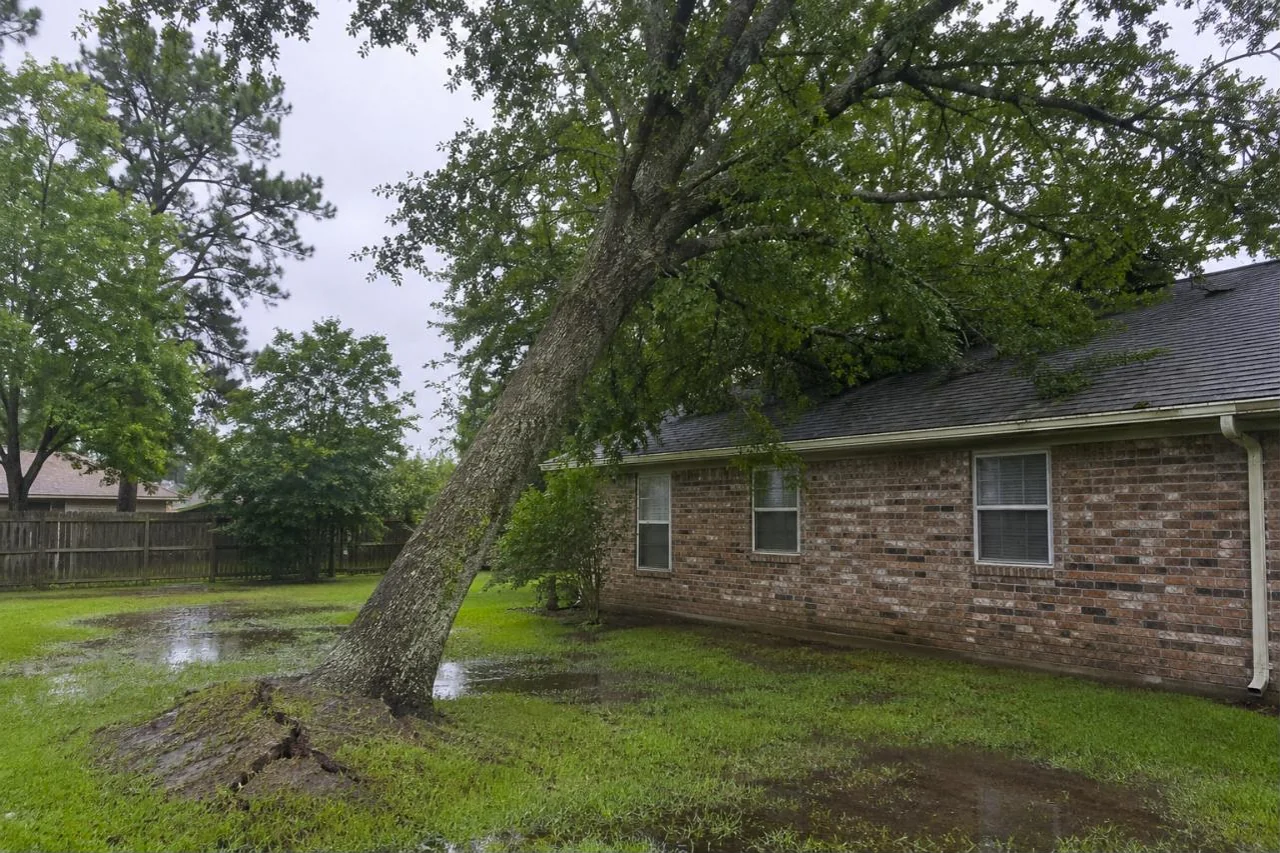
- A new lean, especially toward the house, with the soil on the far side lifted, cracked or showing roots.
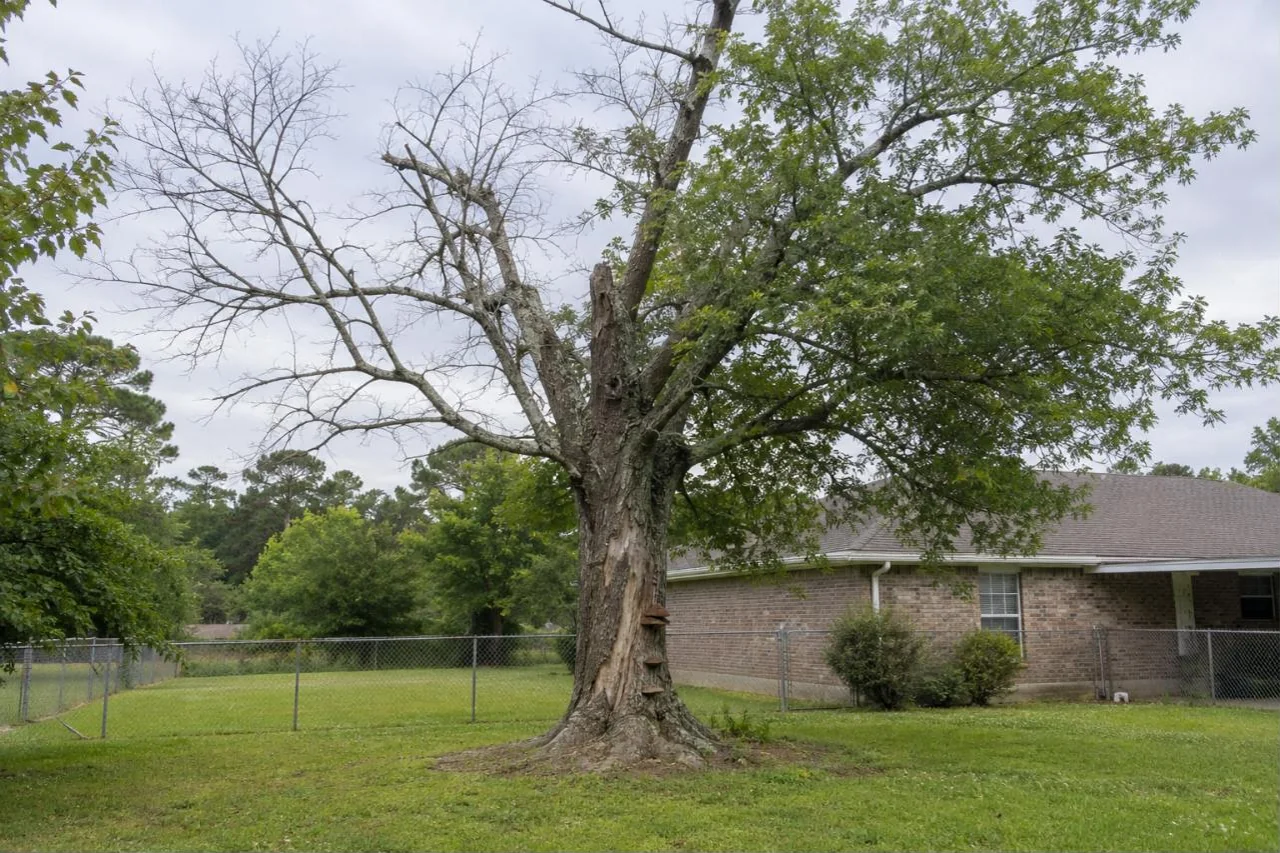
- A thin or bare crown while the trees around it are fully leafed out, or leaves that fade from dark green to light green in a dry summer.
- Bark peeling off in patches or long strips, sometimes with a tan, powdery layer showing underneath.
- Fungus: shelf-like brackets on the trunk or mushrooms around the base.
- Cavities and old wounds where a limb tore out, especially soft or hollow inside.
- Mud tubes on the trunk, or termites in the soil between the root flares or in old pruning scars.
- A pine browning from the top down, with sawdust in the bark crevices or piled at the base.
- Broken limbs hanging in the crown after a storm.
One sign alone doesn't always doom a tree, but two or three together on a big tree near the house do warrant a contractor's look.
When a lean starts after heavy rain
Livingston Parish's own soils explain a lot of leaning trees. The Colyell and Satsuma series, both with type locations in the parish, are somewhat poorly drained, with a clay-rich subsoil from about a foot down and a perched water table 1.0 to 2.5 feet below the surface from December through April (USDA, checked Nov 11, 2026). Roots stay in that shallow top layer, and the ground is softest in the same months that winter storms and spring tornadoes arrive.
LSU AgCenter describes the trees most likely to fall as a "Victim Tree – a shallow-rooted tree with a high center of gravity that is weighed down by a dense canopy," and says, "In storms they usually either snap or uproot." It singles out water oaks: "These trees have short, shallow roots" (checked Nov 11, 2026). The USDA Forest Service agrees that "Water oak has a shallow, spreading rooting habit," and says sweetgum roots on wet, poorly drained sites are "shallow and wide spreading."
A tree that grew crooked toward the light over decades is a different case from one that moved last week. A sudden lean, cracked soil opposite the direction of lean, or roots lifting out of the ground means the root plate has shifted. If that tree can reach the house, keep people out of the rooms on that side and get it looked at quickly.
Rot in older water oaks
LSU AgCenter is blunt about water oaks. Its "Water Oak Warning" quotes Clemson Extension writers who say "Trunks often rot by the time a water oak is 50 years old," and its author adds that "Large water oaks tend to have broken branches and obvious cavities." Horticulturist Dan Gill puts their life expectancy at "only around 60 years" and says "they frequently blow over in high winds." The USDA Forest Service lists trunk canker, heart rot and trunk borers among the things that damage the species (all checked Nov 11, 2026).
LSU AgCenter's Hallie Dozier described a storm that topped out "a seriously decayed water oak" in a Baton Rouge neighborhood, and wrote that when "a neglected tree — especially large growing species such as oaks and pines — fails and causes damage," all trees suddenly seem dangerous. The water oak guide covers how to judge one and how a hollow one comes down.
Oak dieback after a dry spell
Mississippi State University Extension, writing about the same oaks that grow here, calls Biscogniauxia dieback (formerly hypoxylon canker) "a common cause of oak dieback in Mississippi." The oaks it lists as most affected include both live oak and water oak: "black, blackjack, laurel, live, post, southern red, Texas red, water, and white oaks" (checked Nov 11, 2026).
- What sets it off. "Stresses such as drought, heat, wounds, root damage, toxic chemicals, and other diseases reduce the tree's defenses." Outbreaks often follow a major drought by a year or two.
- What it looks like. A tan, powdery fungal mat forms under the bark, and "Pressure from this cushion causes the bark to peel off in patches or long strips." Later the mat "turns silvery-gray and black pimple-like structures appear on its surface."
- What can be done. "No chemicals are registered for Biscogniauxia dieback of oaks." MSU's advice is to cut down severely infected trees. It also says to burn them, which runs into Louisiana's burning limits; have the wood hauled instead.
LSU AgCenter's Heather Kirk-Ballard makes the same link to drought: "Drought-stressed trees will become more susceptible to diseases such as cankers, root rots, wood rots and wilt," and the first symptom is often "foliage turning from a dark green to light green" (Nov 4, 2022, checked Nov 11, 2026).
Pines that turn brown
Louisiana's forestry office calls the southern pine beetle "Louisiana's most significant forest insect pest," but its 2024 report says activity "has been insignificant since the late 1990's," and that the black turpentine beetle and Ips engravers "remain at relatively normal levels" (LDAF, checked Nov 11, 2026). In a yard, the pine to watch is one under stress.
LSU AgCenter says beetles go after pines stressed by "drought stress, lightning strike, windstorm damage or other physical or mechanical injuries." The signs: "the affected parts of the tree will turn brown," and "Sawdust is present between the bark crevices and accumulates around the base of the tree trunk," with small round exit holes in the bark. Its advice is direct: "Pine trees infested with Ips beetles should be removed," because "Once a tree is infested, chemical treatment is ineffective." Don't stack fresh-cut pine logs near healthy pines, and water pines through long dry spells (Nov 18, 2022, checked Nov 11, 2026).
A tall pine standing alone in a yard is also the one most exposed to wind and lightning. The USDA Forest Service says of loblolly pine that "Large dominant trees usually are more vulnerable to high winds than smaller trees," and "Large, dominant, open-grown trees are generally the most vulnerable to lightning strikes."
Termites living inside the trunk
LSU AgCenter's guide to Formosan subterranean termites says they "can make a meal out of almost any live tree," hollowing it "until it can no longer support itself, causing the tree to fall," and that "The termite nest inside the tree can house millions of termites." Signs to look for: "shelter tubes constructed on the exterior of the trunk," termites in the soil between the root flares, and termites in pruning scars, which are "especially active in the spring during swarm season." LSU researchers found the termites "showed a preference for pecan trees" (checked Nov 11, 2026).
An infested tree can be treated. If it's already hollow and leaning toward the house, removal is usually the safer answer.
After floodwater sits around the roots
Weeks after the August 2016 flood, which reached roughly three-quarters of the homes in Livingston Parish, LSU AgCenter's Dan Gill explained what standing water does: "Flooding primarily impacts landscape plants by saturating the soil," and when soil pores stay full of water for an extended period, "the roots are deprived of the oxygen they need and they may drown." He called root rot and drowning "the greatest damage posed to landscape plants caused by flooding" (WRKF, Sep 3, 2016, checked Nov 11, 2026). That damage shows up slowly, as thinning crowns and dieback over the following seasons, not as a tree falling the day the water goes down.
When the city steps in
Inside Denham Springs, the landscape ordinance lets the city's landscape review coordinator require an owner to treat diseased or pest-infested trees or let the city treat them. If drastic action is needed to protect healthy trees, the owner must cut and destroy the trees or "allow the city to do so, charging the actual cost involved to the property owner" (city's posted copy of Ch. 78, checked Nov 11, 2026).
When it's the neighbor's tree
A dead tree next door that leans your way is a conversation first. Louisiana Civil Code article 688 lets you demand that a neighbor trim branches or roots that extend onto your property and interfere with its use, at the neighbor's expense. A tree on the line is presumed to be owned in common under article 687, and a neighbor who demands its removal bears the cost. Never cut a tree that isn't yours without consent: La. R.S. 3:4278.1 makes the cutter liable for three times its fair market value (all checked Nov 11, 2026).
Can the tree be saved?
- A young water oak can be trained to a single trunk and pruned regularly with small cuts, as LSU AgCenter's water oak article suggests.
- A live oak with storm breakage is often worth trimming back to sound wood; live oak is among the most wind-resistant trees in the University of Florida's rankings.
- A pine under drought stress may pull through with water, but once beetles are in it, LSU says remove it.
- An oak with dieback has no registered chemical treatment, per MSU Extension.
- A tree with termites can be treated if it's still structurally sound.
Failing-tree questions answered
My oak has fungus growing at the base. Is it dying?
Fungus at the base can be a sign of decay in the roots or lower trunk, which you can't see from outside. On a big tree near the house, have it looked at, and ask whether the contractor can check how much sound wood is left.
Should a leaning tree come down right away?
If the lean is new, the soil is cracked or lifted, and the tree can reach the house, treat it as urgent. A tree that has grown at the same angle for years is a different case, though a big one near the house is still worth a look.
My pine browned out over a few weeks. Can it be sprayed?
LSU AgCenter says chemical treatment is ineffective once Ips beetles are in a tree and that infested pines should be removed. Ask that the logs be hauled away, not stacked near your other pines.
Will the city make me remove a dead tree?
Inside Denham Springs, the ordinance lets the city require treatment or removal of diseased trees in some cases, at the owner's cost. Outside the city, no parish tree ordinance turned up.
Ask about a dead or leaning tree through this site and the request reaches a single independent contractor in Livingston Parish. The site does no tree work itself.
Where this comes from
- LSU AgCenter: Working in the Landscape: Water Oak Warning (Aug 13, 2020); Dan Gill, As strong as an oak (Dec 2014); Choosing trees for hurricane resistance (Jan 14, 2007); Hallie Dozier, News from the urban side (Sep 16, 2020); Heather Kirk-Ballard, drought stress (Nov 4, 2022); Damaging pest on the rise in Louisiana pines (Nov 18, 2022). Checked Nov 11, 2026.
- LSU AgCenter, Pub. 3092, Detecting Termites in Trees, and Louisiana Agriculture, fall 2007; Dan Gill, flood damage to your landscape (WRKF, Sep 3, 2016). Checked Nov 11, 2026.
- Mississippi State University Extension, The Plant Doctor: Biscogniauxia (Hypoxylon) Dieback of Oaks (IS1798). Checked Nov 11, 2026.
- LDAF Office of Forestry, Louisiana Forest Health Highlights 2024; USDA Forest Service, Silvics of North America: water oak, loblolly pine, sweetgum. Checked Nov 11, 2026.
- USDA official soil series descriptions, Colyell and Satsuma; Brown et al., Journal of Hydrometeorology, 2020. Checked Nov 11, 2026.
- City of Denham Springs, Landscape Ordinance; Louisiana Civil Code art. 687 and art. 688; La. R.S. 3:4278.1 (FindLaw copy); UF/IFAS, FR173. Checked Nov 11, 2026.