
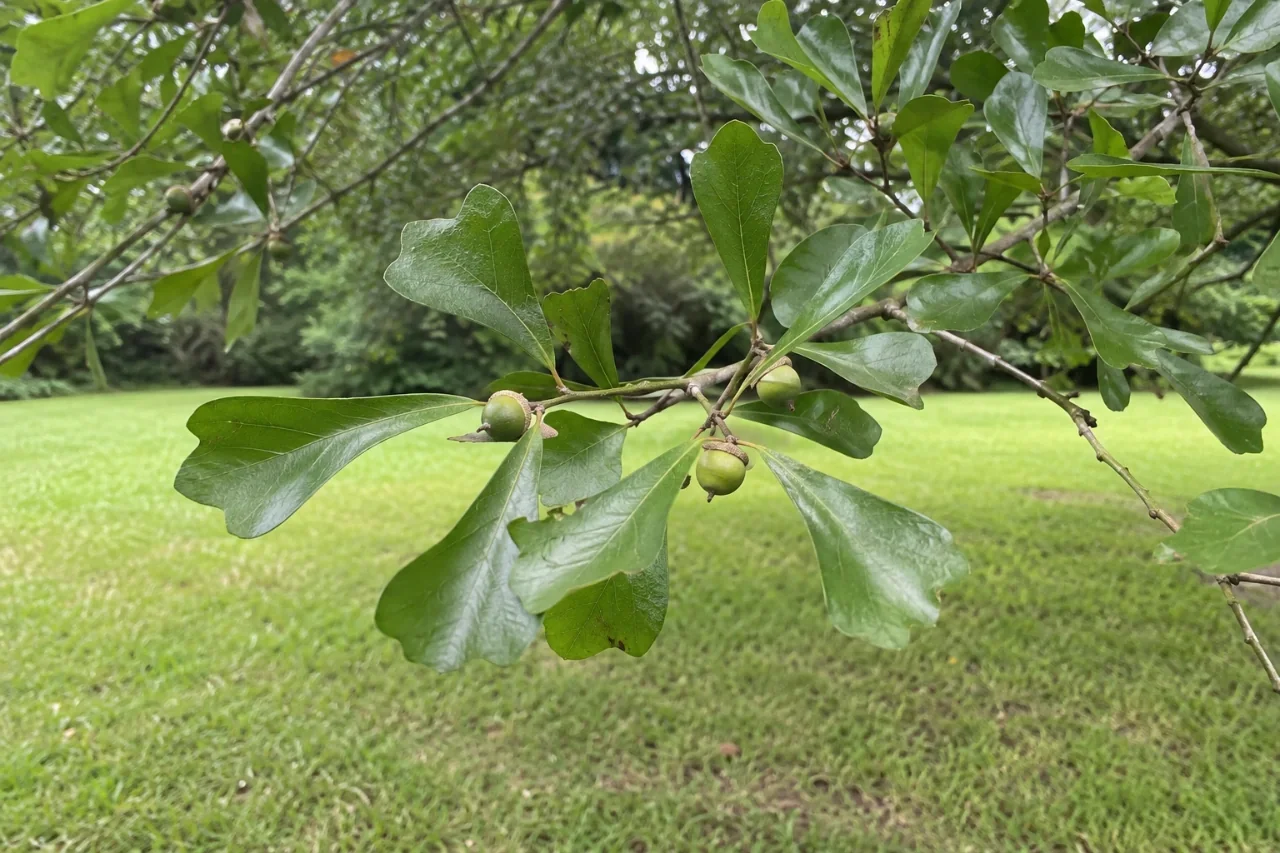
How to recognize a water oak
LSU's horticulture department describes Quercus nigra as averaging 60 feet tall and 40 feet wide, with a "Simple leaf, spatula-shaped, with 3 lobes at apex although irregular." The leaves "turn from dull yellow to brown and drop over an extended period from early autumn through late winter," which is why the Clemson Extension writers quoted by LSU AgCenter say that "In warmer climates leaves drop all winter, making raking a constant task." It also notes that the many seedlings a water oak drops "may also become a maintenance issue" (checked Nov 11, 2026).
It's a fast grower. The USDA Forest Service says water oak "can produce 15 to 30 cm (6 to 12 in) of d.b.h. growth in 10 years" on good sites and can reach 125 feet. That speed is part of the problem: a water oak planted near a new house gets big, and heavy, quickly.
Don't confuse it with live oak, which the University of Florida ranks in its most wind-resistant group, or with laurel oak, which it ranks among the least wind-resistant, alongside water oak. If you're not sure what you have, a contractor can tell you on site.
Why water oaks fail
Extension experts, LSU AgCenter's among them, don't mince words about this tree:
- "The water oak, for instance, grows quite rapidly for an oak," but "it has relatively brittle wood that is prone to decay," "they frequently blow over in high winds," and they have "a short life expectancy of only around 60 years" (Dan Gill, LSU AgCenter, Dec 2014).
- "It is more weak-wooded than most oaks and prone to damage from wind, snow and ice." "It does not resist decay well, and damaged wood will begin to decay and decline" (Clemson Extension writers Debbie Shaughnessy and Bob Polomski, as quoted in LSU AgCenter's "Water Oak Warning," Aug 13, 2020).
- "Mature water oaks were severely damaged along Hurricane Andrew's path." "These trees have short, shallow roots" (LSU AgCenter, "Choosing trees for hurricane resistance," Jan 14, 2007).
- "Sometimes the Water Oak may be considered a liability in the landscape," with "relatively weak wood compared to other oaks that causes substantial branch breakage and decay" (LSU horticulture plant page).
The University of Florida's hurricane research puts water oak in its "Lowest Wind Resistance" group for the Southeastern Coastal Plain, alongside laurel oak, pecan, Chinese tallow and Callery pear. Live oak and bald cypress sit in the highest group (UF/IFAS FR173). All sources checked Nov 11, 2026.
Why it matters on Livingston Parish ground
The USDA Forest Service says water oak's "Best development and highest quality are found on the better-drained silty clay or loamy soils," while "On low flats with poorly drained clay soils, tree form and quality are poor," and it describes "a shallow, spreading rooting habit" (checked Nov 11, 2026).
The two soil series whose type locations are in Livingston Parish, Colyell and Satsuma, are both somewhat poorly drained, with a perched water table 1.0 to 2.5 feet down from December through April (USDA, checked Nov 11, 2026). Put a fast-growing, heavy-crowned tree with shallow roots on ground that stays wet half the year, and you have LSU's definition of a storm victim: "a shallow-rooted tree with a high center of gravity that is weighed down by a dense canopy."
The storm record here shows what large falling trees do, though the Weather Service doesn't say what kind they were. In Hurricane Gustav, a Livingston Parish woman was killed when high winds toppled a large tree onto her mobile home. In the February 2017 tornadoes, hardwoods near Killian were "snapped and uprooted falling on a home, shed, and several vehicles" (NWS New Orleans/Baton Rouge, checked Nov 11, 2026).
Warning signs on a water oak
- Age. A trunk 50 years old or more, given the Clemson note, quoted by LSU AgCenter, that trunks often rot by then.
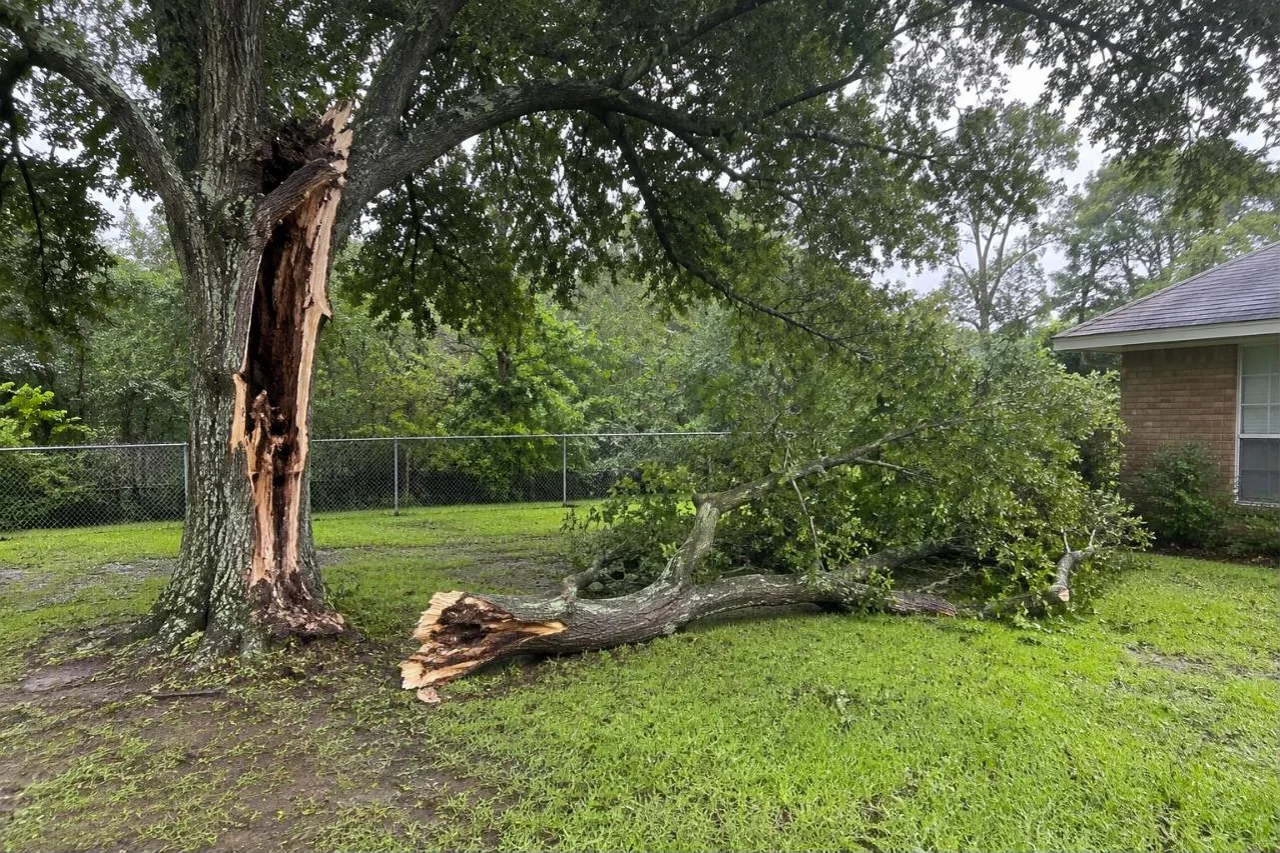
- Cavities and broken branches. "Large water oaks tend to have broken branches and obvious cavities."
- Old wounds. LSU says to watch for damage as the tree ages, since it "will likely be a site for decay."
- Canker and heart rot. The USDA lists "trunk canker and heart rot caused by a variety of organisms," plus trunk borers.
- Peeling bark and dieback after a dry year. Mississippi State University Extension lists water oak among the oaks most affected by Biscogniauxia (hypoxylon) dieback, which often follows drought.
- Termite tubes on the trunk, since LSU AgCenter says Formosan termites can hollow almost any live tree.
- Position. Within reach of the house, a carport or shed, or a parking area: the article names homes, improvements and parking areas.
A young, healthy water oak
Not every water oak has to go. LSU AgCenter says "water oaks can be good shade trees in the first 30 or 40 years," and "If you have a younger water oak, enjoy it while it is healthy and robust." The pruning advice it passes along from the Clemson writers: "Train this tree to a central trunk, pruning to keep the main branches spaced 2 feet or more apart," and "Prune regularly to avoid making large pruning wounds that may cause decay." Expect the lower branches to droop as the tree ages, and expect grass to struggle under it, since its shallow, spreading roots compete for water and nutrients (checked Nov 11, 2026). The trimming guide covers the rest.
How a hollow water oak comes down
Rotten wood doesn't behave like sound wood. A hinge cut that would steer a healthy trunk can fail in a hollow one, and a climber's tie-in point has to be in sound wood. That's why a big decayed water oak beside a house is usually taken apart in sections on ropes, or lifted out with a crane, rather than felled whole. Ask the contractor how they'll check the trunk and where each piece will go.
National guides price the work like this (all checked Nov 11, 2026):
| Item | Source | Range |
|---|---|---|
| Oak removal, average | HomeGuide | $250 – $2,500 |
| Mature oak removal | HomeGuide | $3,000 – $6,000 |
| Oak removal | Forbes Home | $700 – $2,000 |
| Crane, added per day | HomeGuide | $500 – $2,500 |
| Crane, added per day | Forbes Home | $250 – $600 |
| First stump, ground | HomeGuide | $120 – $400 |
These are national figures, not Denham Springs prices. The tree work prices page has the full tables; only a written price from a contractor who has seen your oak tells you the real cost. Count on hauling being part of it: Waste Pro in Denham Springs and Waste Management in Walker won't take debris from a tree service (checked Nov 11, 2026). The stump calls for a Louisiana 811 locate first; see stump grinding.
Permits for a water oak
On an ordinary home lot, none turned up in Denham Springs, Walker or the unincorporated parish (checked Nov 11, 2026). Denham Springs' native-tree table, used within its permits for clearing an acre or more and for development, lists white, red, cherrybark, overcup, cow, Nuttall, willow, Shumard and live oaks, but not water oak, in the copy of the ordinance the city posts. A water oak in a street or road right-of-way still needs the city's, the parish's or DOTD's permission. The rules guide has the details.
What to plant in its place
LSU AgCenter's "Water Oak Warning" points to its Native Tree Growing Guide, which suggests live oak, Nuttall oak, cherrybark oak and Shumard oak, and notes that the Louisiana Super Plants program recommends willow oak. "There are enough oaks for selection to replace any failed water oak in the landscape." Dan Gill adds that Nuttall and Shumard oaks "live longer (over 100 years) and are not so prone to trunk rot as the water oaks" (checked Nov 11, 2026).
Give the replacement room. LSU's Allen Owings says live oaks "need to be planted on 90-foot centers," and DEMCO says to "never plant trees near a power line right-of-way." More choices are on the Livingston Parish trees page.
Water oak questions answered
My water oak looks healthy. Should I take it down anyway?
Not necessarily. LSU AgCenter says younger water oaks can be good shade trees for 30 or 40 years. Age, cavities, broken limbs and closeness to the house are what tip the balance toward removal.
How can I tell if the trunk is hollow?
Cavities, fungus, and soft or crumbling wood at old wounds are clues. A contractor can look more closely, and should, before anyone climbs a tree that might be rotten.
Is a water oak protected in Denham Springs?
Water oak isn't in the native-tree table of the city's posted landscape ordinance, and that table applies within the city's clearing and development permits anyway. An ordinary home-lot removal doesn't need a city permit.
Can the wood be used for firewood?
Sound sections can be split and stacked; rotten ones are better chipped or hauled. Tell the contractor what you want to keep.
Water oak requests from this site are passed to one independent contractor working in Livingston Parish. The site itself doesn't remove trees.
Where this comes from
- LSU, Quercus nigra plant page; LSU AgCenter, Working in the Landscape: Water Oak Warning (Aug 13, 2020); Dan Gill, As strong as an oak (Dec 2014); Choosing trees for hurricane resistance (Jan 14, 2007); Allen Owings, Southerners love live oaks (Feb 27, 2015). Checked Nov 11, 2026.
- USDA Forest Service, Silvics of North America, Quercus nigra (J. A. Vozzo); UF/IFAS, Wind and Trees: Lessons Learned from Hurricanes (FR173); Mississippi State University Extension, Biscogniauxia (Hypoxylon) Dieback of Oaks; LSU AgCenter, Pub. 3092. Checked Nov 11, 2026.
- USDA official soil series descriptions, Colyell and Satsuma; NWS New Orleans/Baton Rouge, Gustav summary and Killian tornado survey. Checked Nov 11, 2026.
- City of Denham Springs, Landscape Ordinance; DEMCO, right-of-way maintenance; Waste Pro, Denham Springs; City of Walker, city flyer. Checked Nov 11, 2026.
- HomeGuide, tree removal cost; Forbes Home, tree removal cost (verified Oct 1, 2024). Checked Nov 11, 2026.