
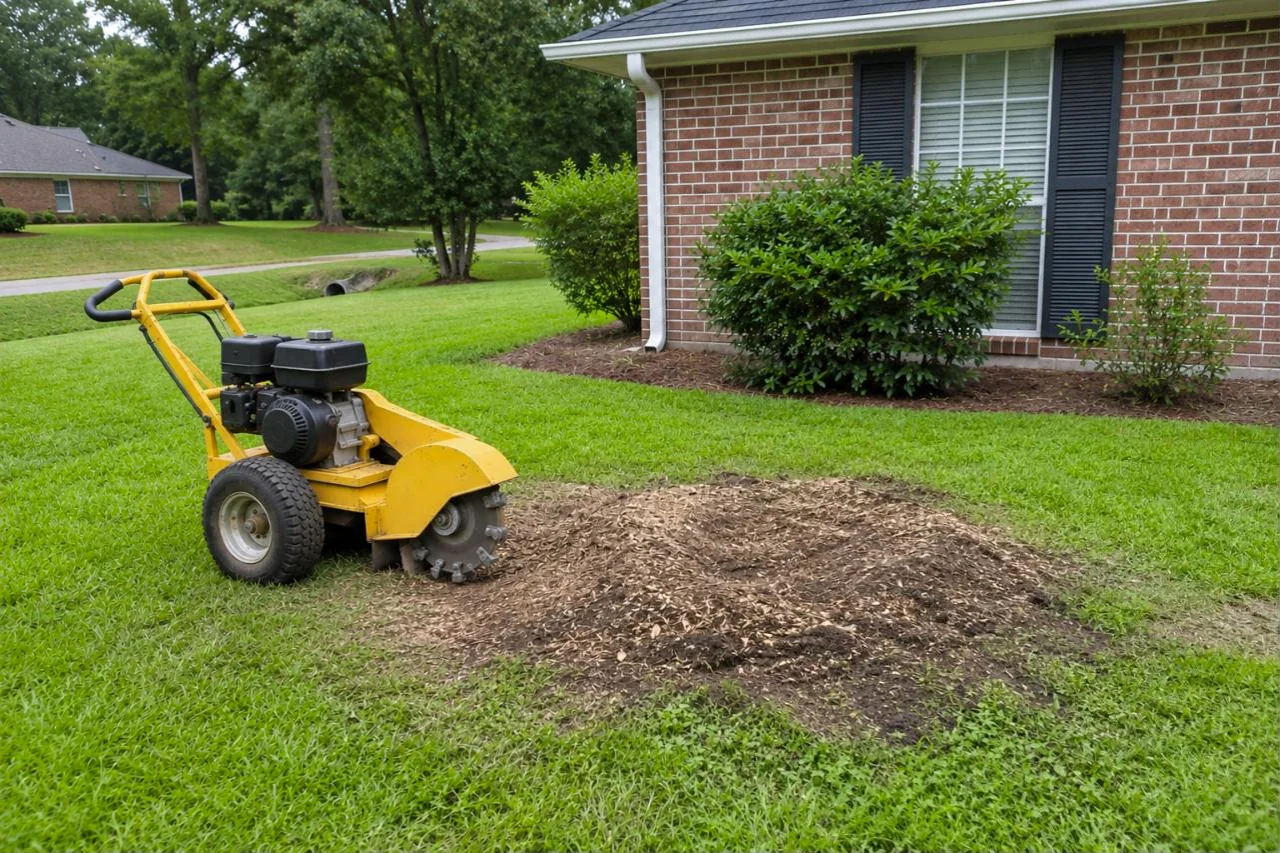
Grind it, pull it, or let it be
Three choices, each with a different result:
- Grinding. The machine shaves the stump down a few inches to several inches below grade. The roots are left to decay underground. HomeGuide notes that "Stump grinding does not include root removal" (checked Nov 11, 2026).
- Digging it out. The stump and its main roots come out of the ground, leaving a larger hole to fill. HomeGuide lists digging out a stump at about $80 to $190 each, and root removal at $75 to $150 an hour (checked Nov 11, 2026).
- Leaving it. A stump cut flush or low adds nothing to the bill and can sit in a back corner for years. It gets in the way of mowing, a new bed or a driveway.
Grinding usually suits a spot that will go back to lawn; digging out suits a spot where something will be built or poured. Tell the contractor what you plan for it.
Louisiana 811 and the notice window
Louisiana's Underground Utilities and Facilities Damage Prevention Law says each excavator "shall serve telephonic or electronic notice of the intent to excavate" to the notification center "at least forty-eight hours," "but not more than one hundred twenty hours, excluding weekends and holidays," before the work begins (La. R.S. 40:1749.13(B)(1), as amended in 2026, checked Nov 11, 2026). The 120-hour cap means a request made too early has to be made again.
The law defines excavation broadly: "any operation causing movement or removal of earth, rock, or other materials in or on the ground" by "powered or mechanical or manual means," naming digging, augering, boring, grading and more (La. R.S. 40:1749.12, checked Nov 11, 2026). Stump grinding isn't named, but it moves earth below grade with a machine, so this site reads it as excavation. Louisiana 811's homeowner page warns that lines can be damaged by "even planting trees."
- How to ask. Call 811 or 1-800-272-3020, or use Louisiana 811's online ticketing. The call center works Monday through Friday, 7 a.m. to 6 p.m., with emergency locates around the clock (checked Nov 11, 2026).
- Timing. Louisiana 811 tells homeowners to call at least two business days ahead, and requests made after 6 p.m. on a weekday are processed the next business day.
- Marking. Outline the dig area in white so the locators know where to look.
- Who calls. Settle in writing whether you or the contractor makes the request, and get the ticket number.
The law's exemption for "land owners excavating their own underground utilities or facilities" on their own property is narrow. It's about digging up your own line, not grinding a stump next to someone else's.
Lines nobody will mark
A locate covers the utilities that belong to 811's members, and only so far. Louisiana 811 says utilities usually mark only to the meter or the start of the service line; where the meter isn't on the building, "the lines from the meters to your structures are your responsibility." It also says some operators, such as small-town municipal water and sewer systems, aren't members and won't be marked unless you contact them directly (checked Nov 11, 2026).
The City of Denham Springs runs its own natural gas system and handles gas lines and meters, including some beyond the city limits. Its gas page puts it simply: "811 only marks public utility lines." A propane line from a tank to the house, or any other private line, needs a private locator. The city's gas emergency number is (225) 667-8346 (checked Nov 11, 2026).
Before grinding starts, show the contractor anything buried near the stump that you know about: a propane line, a well line, sprinkler pipe, landscape lighting wire, a line to a shop or pool.
Wet clay under the stump
The two soil series whose type locations are in Livingston Parish, Colyell and Satsuma, are silty at the surface with a clay-rich layer starting about a foot down, and both hold a perched water table 1.0 to 2.5 feet below the surface from December through April (USDA, checked Nov 11, 2026). Grinding in that season can turn the hole into a pocket of mud and chips, and a grinder on soft ground can rut the lawn getting to the stump. A drier month makes for a cleaner job.
The same wet layer is why roots here run shallow and wide. Surface roots that radiate from an oak stump can be ground along with it for a few feet, at extra cost, if they'd trip a mower.
A stump in the grassy strip by the road may sit in a city, parish or state right-of-way along with the ditch. The same permissions that applied to the tree apply to digging there; see the rules guide.
The chips and the hole
Grinding leaves behind a heap of chips and soil, usually bigger than people expect because the stump's whole volume turns to chips. You can have the crew rake the chips into the hole and leave them, haul them away, or pull most of them out and backfill with topsoil so grass can grow. Wood chips left in the hole break down over time and the spot settles, so expect to top it up.
Ask which of these the price includes. Hauling chips adds work, and the curbside haulers in Denham Springs and Walker won't take debris left by a tree service (checked Nov 11, 2026).
Stumps and wood from sick trees
If the tree died from pine beetles, keep the wood away from the pines you still have. LSU AgCenter advises against stacking fresh-cut pine logs near healthy pines and says beetle-infested pines should be removed (checked Nov 11, 2026). For oaks killed by Biscogniauxia (hypoxylon) dieback, Mississippi State University Extension's guidance for the same oak species is to cut down severely infected trees. Its advice to burn them runs into Louisiana's burning limits, covered on the rules page, so ask the contractor to haul that wood off instead.
Grinding prices by stump width
HomeGuide prices grinding by diameter, measured across the base of the trunk rather than just the cut surface, at "$2 to $6 per inch on average" (checked Nov 11, 2026):
| Stump diameter | HomeGuide range |
|---|---|
| 12 in. or less | $30 to $70 |
| About 24 in. | $50 to $150 |
| About 36 in. | $70 to $220 |
| About 48 in. | $100 to $290 |
| About 60 in. | $120 to $360 |
| About 72 in. | $150 to $430 |
On HomeGuide, a minimum visit runs $80 to $160, and hourly grinding $100 to $200. Angi's figure for stump removal is $100 to $150 for the first and about $50 apiece after that; Forbes Home's figure for grinding is roughly $300 to $400; Thumbtack's 2026 guide puts removing a tree and its stump at $1,072 on average (all national, checked Nov 11, 2026).
Worked example: one stump versus three
Take a single 24-inch oak stump. HomeGuide's table gives $50 to $150 for that width, but its minimum service charge of $80 to $160 can set the real floor for a one-stump visit. Now add two smaller stumps on the same visit: HomeGuide's "additional stump" rate of $30 to $60 each adds $60 to $120. That's why grinding every stump on the lot in one trip usually works out better than one at a time. These are national figures used only to show the arithmetic; the contractor's written price is what counts.
Stump mistakes to skip
- Grinding before the locate. Or after the ticket has gone stale past the 120-hour mark.
- Forgetting the propane line. 811 won't mark it.
- A mud pit in February. Wet-season grinding in clay can leave a mess that takes weeks to settle.
- No plan for the chips. A heap of chips and clay in the front yard is still there next month unless someone hauls or spreads it.
- Grinding the neighbor's stump. On a boundary, settle ownership first; Civil Code article 687 presumes boundary trees are common.
Stump questions answered
Do I really need to call 811 for a stump?
Grinding moves earth below grade with a machine, which is how this site reads "excavation" under Louisiana law, and the law requires notice at least 48 hours ahead. Louisiana 811 doesn't charge the person digging for a locate, and it can keep a grinder out of a gas or electric line.
How deep does the grinder go?
Ask the contractor; it depends on the machine and on what you'll do with the spot. Deeper grinding costs more and is worth it if you're planting or laying sod.
Can I plant a new tree where the old stump was?
Usually a few feet to one side works better, since old roots and decaying chips stay in the ground. LSU AgCenter suggests live oak, Nuttall oak, cherrybark oak and Shumard oak as replacements for a failed water oak; see what to plant.
Will the stump grow back?
Some trees sprout from roots or the stump after cutting. Grinding below grade usually stops it; if sprouts appear, cut them back as they come.
Stump requests made here are passed to a single independent contractor working in Livingston Parish. This site doesn't do the grinding.
Where this comes from
- La. R.S. 40:1749.13 (history through Acts 2026, No. 902) and La. R.S. 40:1749.12. Checked Nov 11, 2026.
- Louisiana 811, home page and homeowners page; City of Denham Springs, Gas Department. Checked Nov 11, 2026.
- USDA official soil series descriptions, Colyell and Satsuma. Checked Nov 11, 2026.
- LSU AgCenter, Damaging pest on the rise in Louisiana pines (Nov 18, 2022) and Water Oak Warning (Aug 13, 2020); Mississippi State University Extension, Biscogniauxia (Hypoxylon) Dieback of Oaks. Checked Nov 11, 2026.
- Waste Pro, Denham Springs; City of Walker, city flyer; Louisiana Civil Code art. 687. Checked Nov 11, 2026.
- HomeGuide, stump grinding cost (no update date shown); Angi, tree removal cost (2025 data); Forbes Home, tree removal cost (verified Oct 1, 2024); Thumbtack, tree removal cost guide (updated Oct 23, 2026). Checked Nov 11, 2026.