
When a permit comes into it
Most removals at existing homes need no permission from anyone. These are the cases that do, from the city, parish and state documents read for this site (checked Nov 11, 2026):
- Clearing an acre or more in Denham Springs. The city's landscape ordinance says a property owner must get a tree removal permit "Prior to clearing any tract of one acre or more," and for clearing tied to commercial work or residential development on sites over one acre. Removing a tree without a required permit is a public nuisance carrying a fine of $150 a day for each tree, in the copy of the ordinance the city posts.
- A tree in the strip along the street. In Denham Springs, nobody, utilities included, may remove a tree growing in a dedicated street area without the city's permit. On a parish road, Public Works lists tree removal in a right-of-way as needing the Director's approval. Along a state highway, DOTD's vegetation maintenance permit applies.
- Land clearing in Walker. Walker's development code requires a Land Clearing Notification or Fill Permit for clearing, but it excludes clearing a single subdivision lot or a conforming residential lot for one house. See the Walker page.
- Development on parish land. The parish's subdivision and commercial ordinances require an approved Drainage Impact Study before any clearing of a development site. That's for developers, not a homeowner's yard.
- Your subdivision's covenants. No source read for this site covers HOA tree rules, so read your deed restrictions before you book anyone, especially for a healthy tree.
The rules guide walks through each of these, plus burning and the power line law.
Whose tree is it?
Two Louisiana laws matter when a tree sits near the property line. Civil Code article 687 says trees on the boundary "are presumed to be common unless there be proof to the contrary," and a neighbor may demand removal of a boundary tree that interferes with the enjoyment of his property, but he "must bear the expense of removal" (checked Nov 11, 2026).
Cutting a tree that turns out to be the neighbor's is expensive. La. R.S. 3:4278.1 makes it unlawful to cut trees on someone else's land without the owner's consent, and a person who does it willfully owes three times the trees' fair market value plus reasonable attorney fees. Someone acting in good faith can owe treble damages too, if they should have known they lacked consent (FindLaw copy of the statute, checked Nov 11, 2026). If the line isn't clear, settle it before the saw starts.
How a big oak comes down beside a ranch house
A tree can be dropped in one piece only when there's open ground in front of it longer than the tree is tall. A backyard often doesn't have that much room between an oak and the house, a carport or a fence. So the contractor picks a method after walking the lot:
- Felling whole. The crew cuts a wedge-shaped notch facing the direction of fall, then a back cut from the opposite side, and the trunk tips along that line. It fits open rural lots better than a subdivision backyard.
- Piece by piece. A climber or a bucket truck takes off the limbs, then cuts the trunk down a few feet at a time. Anything above the roof or carport is roped and lowered.
- With a crane. When a big tree hangs over the house and pieces can't be lowered safely, a crane lifts them out. It needs a place to set up: a solid driveway or pad, clear air above, and ground firm enough for its outriggers.
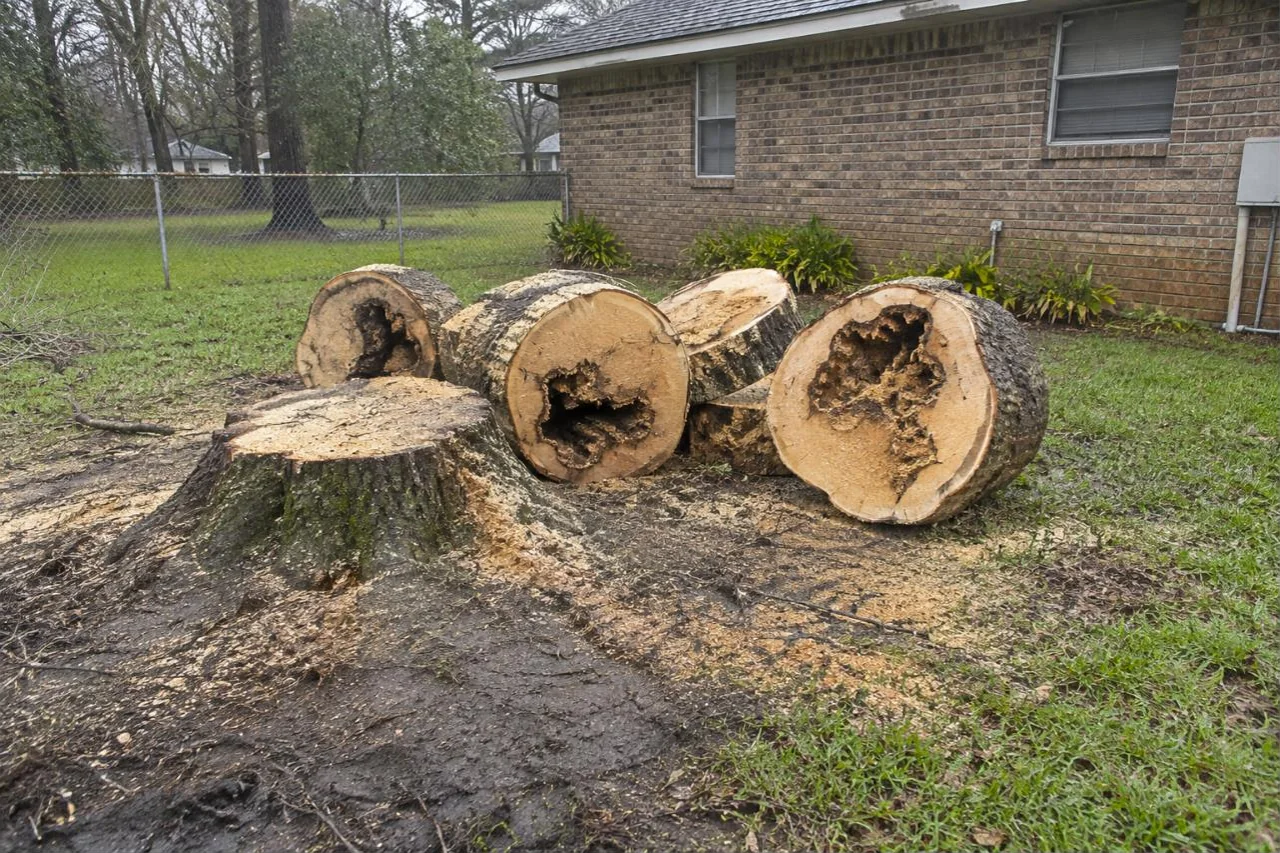
Two local tree types change the plan. A live oak's limbs can reach far out and low, sometimes resting on the roof, so each one comes off in sections. And an old water oak may be hollow: an LSU AgCenter article quotes Clemson Extension writers who say water oak trunks "often rot by the time a water oak is 50 years old" (checked Nov 12, 2026). Rotten wood doesn't break the way sound wood does, which makes a decayed tree harder to climb and to fell, and a reason big hollow oaks near houses often end up as rigging or crane jobs. The water oak guide goes further.
Soggy clay from December to April
Two soils whose official type locations are in Livingston Parish, Colyell and Satsuma, are both described by the USDA as somewhat poorly drained, silty on top over a clay-rich subsoil that starts about a foot down, with a perched water table 1.0 to 2.5 feet below the surface from December through April. The Colyell description puts mean annual rainfall at 64 inches (USDA official series descriptions, checked Nov 11, 2026).
That's why a lawn that holds up fine in October can rut badly under a loaded bucket truck in February. Crews handle that by putting down mats, switching to lighter equipment, or rescheduling for dry weather. Ask how they'll get to the tree and what they'll do about the lawn if it rains the day before.
The same wet layer keeps roots shallow, which matters for the trees you keep. Trucks parked on the root zone and log piles left for weeks compact soil that already holds too much water. Keep equipment off the roots of the oak that's staying.
The wire to the house and the lines on the poles
Louisiana's Overhead Power Line Safety Act bars work that could bring a person or equipment within 10 feet of a high-voltage line (over 600 volts) unless the line's owner has been notified at least 48 hours ahead, not counting weekends and holidays, and safety arrangements have been agreed (La. R.S. 45:141 to 45:143, checked Nov 11, 2026). Homeowners shouldn't cut near a line at all.
The service wire running to your house is handled differently. In Entergy's words: "We DO NOT trim service lines." It adds that the line from the house to the first pole "is the responsibility of the property owner," and that it can have the line temporarily disconnected so you or your contractor can remove the trees or limbs (checked Nov 11, 2026). DEMCO's line clearance manual doesn't say how it handles the service line, so call DEMCO and ask. Your power bill shows which company serves you: Entergy at 800-368-3749, DEMCO at 1-844-693-3626 (checked Nov 11, 2026).
Getting rid of the wood
One large oak leaves trunk sections, heavy limbs and a pile of brush. Here's who takes what (checked Nov 11, 2026):
| Where you live | Curbside rules for limbs | Tree-service debris |
|---|---|---|
| Denham Springs (Waste Pro) | Branches no longer than 6 feet; bulky waste up to 4 cubic yards | Not taken, nor storm debris. Waste Pro: (225) 744-6400 |
| Walker (Waste Management) | Limbs bundled and tied, no more than 4 feet long, 12 inches across or 35 pounds; up to 2 cubic yards | Not collected, and the city can take action against both the contractor and the resident if it's set at the curb |
| Town of Livingston (Waste Management) | Limbs or trunks no more than 35 pounds, 12 inches across or 4 feet long; up to 2 cubic yards of yard waste a week, on garbage day | Ask Town Hall at (225) 686-7153 |
| Unincorporated parish | Depends on your own hauler; Parish Public Works lists roadside litter, white goods and vegetative debris pickup, but no household limb rules turned up | Plan on the contractor hauling it |
Burning. The copy of the state's outdoor burning rule that the Denham Springs Fire Department posts lets a property owner in a parish of 300,000 people or fewer burn leaves, grass, twigs, branches and vines on his own land for noncommercial purposes, attending the fire the whole time. Its separate exception for burning trees and brush covers only parishes of 90,000 or fewer, outside city or town limits, and Livingston Parish has 155,036 (Census Bureau, July 1, 2025). Reading those two together, a felled tree's trunk and big limbs don't fit the homeowner's yard-waste exception. Check for burn bans with the Louisiana Department of Agriculture and Forestry before lighting anything.
Keeping some. Trunk rounds cut to firewood length, or chips spread under shrubs, mean less to haul away.
The stump is its own decision
Grinding a stump digs below grade, which is how this site reads the definition of excavation in Louisiana's damage prevention law, so it should wait for a Louisiana 811 locate requested at least 48 hours ahead (La. R.S. 40:1749.13, checked Nov 11, 2026). Leaving a low stump is also an option. The stump grinding guide covers the rest.
Ways a removal goes sideways
- Not enough room to drop it. A trunk taller than the open ground in front of it lands on something.
- A hollow trunk nobody checked. Rot changes how wood breaks under a rope or a hinge cut.
- The service wire as an afterthought. Limbs tangled in the line to the house come down after the utility disconnects it, not before.
- A pile at the curb. Without hauling in writing, tree-service debris can sit there, since Waste Pro and Waste Management won't take it.
- Ruts in wet clay. A winter job without mats can leave a lawn torn up until summer.
- The neighbor's tree. Cutting without consent can cost three times the tree's value under La. R.S. 3:4278.1.
What removal costs, briefly
HomeGuide puts the typical tree removal at $300 to $2,000, with a national average of $1,150; an oak averages $250 to $2,500 and a mature oak $3,000 to $6,000, and a crane adds $500 to $2,500 a day. Angi's average is $750. Both were checked Nov 11, 2026, and neither is a Denham Springs price. No local price list was gathered for this site, so the price the contractor writes up after seeing your tree is the real number. Every table, with dates, is on the tree work prices page.
If removal isn't the right page
A healthy live oak that's merely crowding the roof may only need trimming. A tree that's already on the roof is a job for the storm and emergency guide. A tree that's tilting or dying has its own guide, dead or leaning trees. Clearing a whole lot is land clearing, and inside Denham Springs a tract of an acre or more needs the city's tree removal permit first.
Removal questions answered
Can I take down a big oak in my Denham Springs backyard without asking the city?
For an ordinary tree on a home lot under one acre, the city's posted ordinance shows no permit for that (checked Nov 11, 2026). Its native-tree size table, which lists live oak from 18 inches in diameter about 4½ feet up, works inside the permit for clearing an acre or more and for development. If you're not sure, call the Building Official at (225) 667-8326.
The tree is in the grass between the ditch and the road. Is it mine?
It may sit in a city, parish or state right-of-way. In Denham Springs a tree in a dedicated street area needs a city permit; on a parish road, the Public Works director's approval; on a state highway, a DOTD permit signed by the owner or lessee of the property (checked Nov 11, 2026). Ask before cutting.
Does the contractor have to haul the wood away?
Only if the agreement says so, which is why it should. In Denham Springs and Walker the curbside hauler won't pick it up after a tree service cuts it.
Can I keep the logs?
Usually. Ask the crew to cut the trunk into stove-length rounds and stack them; less to haul can lower the bill.
How long does a removal take?
It depends on the tree, the access and the weather, so ask the contractor when they see it. A tree dropped whole in an open yard goes much faster than a big oak taken apart over a roof.
Removal requests from this site are passed to a single independent contractor working in Livingston Parish. The site itself doesn't cut trees.
Where this comes from
- City of Denham Springs, Landscape Ordinance (Ch. 78, Art. III, Ord. 08-01 as amended by Ord. 12-09; the Municode version may be newer) and Planning and Development. Checked Nov 11, 2026.
- City of Walker, Unified Development Code (amended Feb 10, 2025) and city flyer. Livingston Parish, Public Works and subdivision ordinances. DOTD, Vegetation Maintenance Permit. Checked Nov 11, 2026.
- Louisiana Civil Code art. 687; La. R.S. 3:4278.1 (FindLaw copy). Checked Nov 11, 2026.
- LSU AgCenter, Working in the Landscape: Water Oak Warning, Aug 13, 2020. USDA official soil series descriptions, Colyell and Satsuma. Checked Nov 11, 2026.
- La. R.S. 45:141, 45:142 and 45:143; Entergy, how tree trimming works; DEMCO, Line Clearance Procedures Manual (Jan 1, 2026). Checked Nov 11, 2026.
- Waste Pro, Denham Springs; Town of Livingston, garbage and yard waste; Denham Springs Fire Department, Outdoor Burning Reference (LAC 33:III.1109); LDAF, fire safety and burn bans; Census Bureau, Livingston Parish QuickFacts; La. R.S. 40:1749.13. Checked Nov 11, 2026.
- HomeGuide, tree removal cost (no update date shown); Angi, how much does tree removal cost (2025 data). Both checked Nov 11, 2026.