
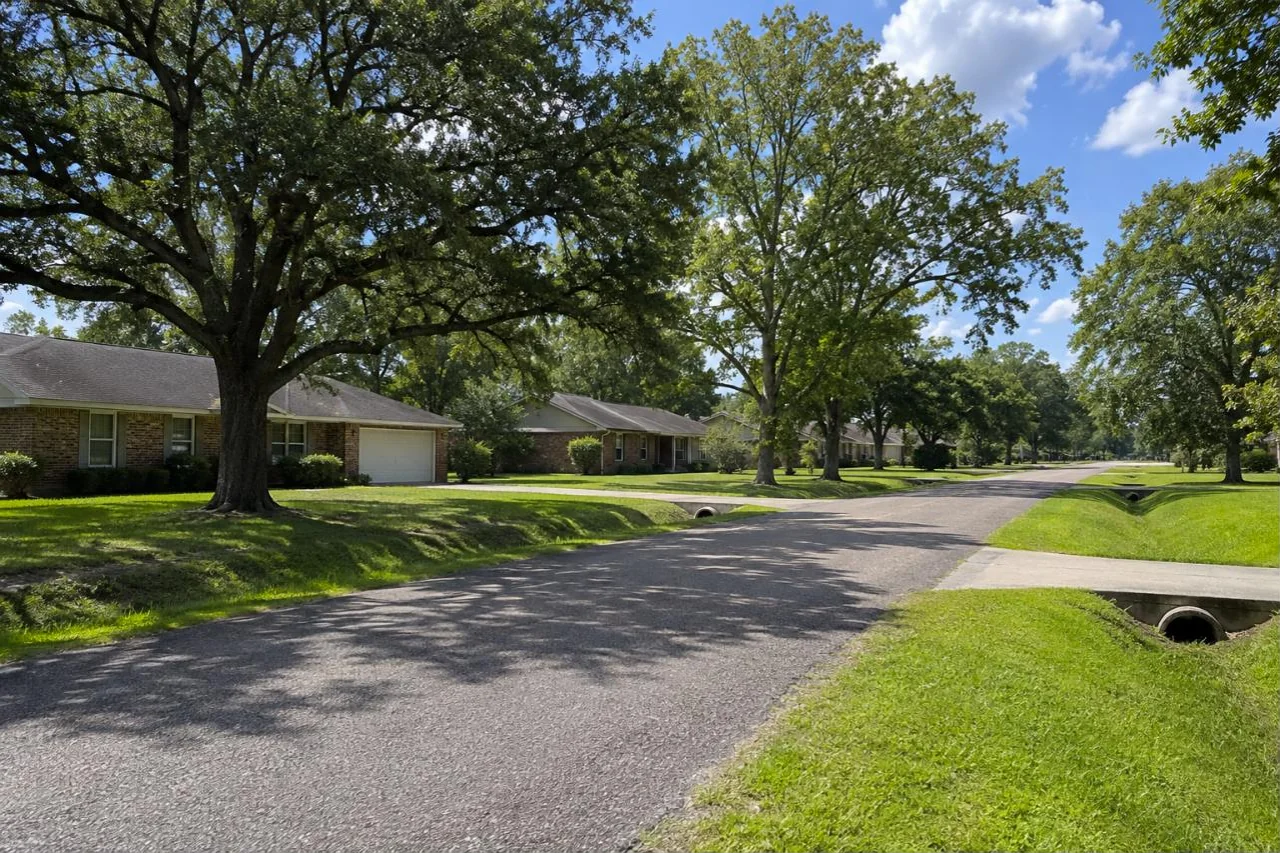
Wind ratings at a glance
Two official lists rate these trees. The University of Florida's FR173 ranks species in four groups for the Southeastern Coastal Plain. LSU AgCenter's 2007 page names "Survivor" trees (a top 10 credited to LSU landscape professor D.G. "Buck" Abbey), other good wind-resistant species, and "'Victim' or Weak-Wood Trees" (both checked Nov 12, 2026). They mostly agree, and where they don't, both are shown.
| Tree | UF/IFAS FR173 group | LSU AgCenter list |
|---|---|---|
| Live oak | Highest | Survivor |
| Bald cypress | Highest | Survivor |
| Southern magnolia | Highest | Good wind resistance |
| Crape myrtle, American holly | Highest | Good wind resistance |
| Sweetgum | Medium-High | Good wind resistance |
| River birch | Medium-High | Good wind resistance |
| Willow oak | Medium-Low | Good wind resistance |
| Red maple | Medium-Low | Not listed (silver maple is a Victim) |
| Sycamore | Medium-Low | Good wind resistance |
| Water oak | Lowest | Severely damaged by Andrew; shallow roots |
| Laurel oak | Lowest | Not listed by name |
| Pecan | Lowest | Victim |
| Chinese tallow | Lowest | Not listed |
| Bradford or Callery pear | Lowest | Victim ("ornamental pears") |
| Pines | Not confirmed for this site | Victim |
LSU defines a victim tree as "a shallow-rooted tree with a high center of gravity that is weighed down by a dense canopy," adding, "In storms they usually either snap or uproot."
Live oak
LSU AgCenter's Dan Gill calls live oak "one of our most hurricane resistant native trees," and Allen Owings wrote that it "was one of the major tree species that survived the wind and flooding of Hurricane Katrina." Owings also wrote that live oaks "need to be planted on 90-foot centers," a reminder of how wide they spread. The Live Oak Society registers more than 7,500 notable live oaks across the South; a tree needs a girth of 8 feet to join, and girths over 16 feet count as centenarians (checked Nov 11, 2026).
Denham Springs' landscape ordinance lists live oak in its native-tree table at 18 inches in diameter, within its clearing and development permits. And strong isn't storm-proof: the February 7, 2017 EF-3 tornado near Watson snapped "Numerous hardwood trees including a large live oak" (NWS New Orleans/Baton Rouge, checked Nov 11, 2026). Most live oak work here is pruning limbs off roofs, not removal.
Water oak
The opposite case. LSU AgCenter's Dan Gill says water oak "grows quite rapidly for an oak" but has "relatively brittle wood that is prone to decay." An LSU AgCenter article quotes Clemson Extension writers who say trunks "often rot by the time a water oak is 50 years old," and its author calls compromised water oaks near homes, improvements and parking areas hazard trees and recommends removing them (checked Nov 12, 2026). The USDA Forest Service says it has "a shallow, spreading rooting habit" and that on "low flats with poorly drained clay soils, tree form and quality are poor." Full details are in the water oak guide.
The other oaks
- Laurel oak sits with water oak in FR173's lowest group.
- Willow oak is Medium-Low in FR173 but on LSU's list of good wind-resistant species, and the Louisiana Super Plants program recommends it, according to LSU AgCenter.
- Nuttall, Shumard and cherrybark oaks appear on LSU's good-wind-resistance lists (Shumard and cow oak are among its top 10 "Survivor" trees). Dan Gill says Nuttall and Shumard oaks "live longer (over 100 years) and are not so prone to trunk rot as the water oaks."
- White, overcup, red and cow oaks are all in Denham Springs' native-tree table, at 18 to 36 inches depending on species (city's posted ordinance, checked Nov 11, 2026).
Loblolly pine
The USDA Forest Service's Silvics of North America says a young loblolly develops a short taproot that "in most cases" gives way to "an extensive lateral-root system," and that "Roots of loblolly generally spread laterally farther than their crowns." A taproot 5 to 6.5 feet long often forms on deep sandy or loamy soils, while "On heavy clay soils, the taproot tends to be stout and short" (checked Nov 12, 2026).
On storms and lightning it's blunt: "Large dominant trees usually are more vulnerable to high winds than smaller trees," "Greater damage frequently occurs from ice or glaze storms," and "Large, dominant, open-grown trees are generally the most vulnerable to lightning strikes." A lone yard pine is exactly that open-grown tree. The largest stand tree it reports measured 53 inches across and 150 feet tall. LSU AgCenter's "Victim" list includes pines, and pines stressed by drought, lightning or wind draw bark beetles; see pines that turn brown.
Sweetgum, red maple and sycamore
Sweetgum rates Medium-High in FR173, and LSU calls it a good wind-resistant species. Its roots depend on the site: on wet, poorly drained ground they're "shallow and wide spreading," while on well-drained bottomland "a deep taproot with numerous well-developed laterals usually develops rapidly." The USDA adds that, apart from leaf feeders, "insects usually attack only trees that are already damaged, decadent, or dead" (checked Nov 11, 2026).
Red maple and sycamore are Medium-Low in FR173, though LSU lists sycamore among its good wind-resistant trees. LSU's victim list includes silver maples, box elders, cottonwoods, willows and hickories.
Bald cypress
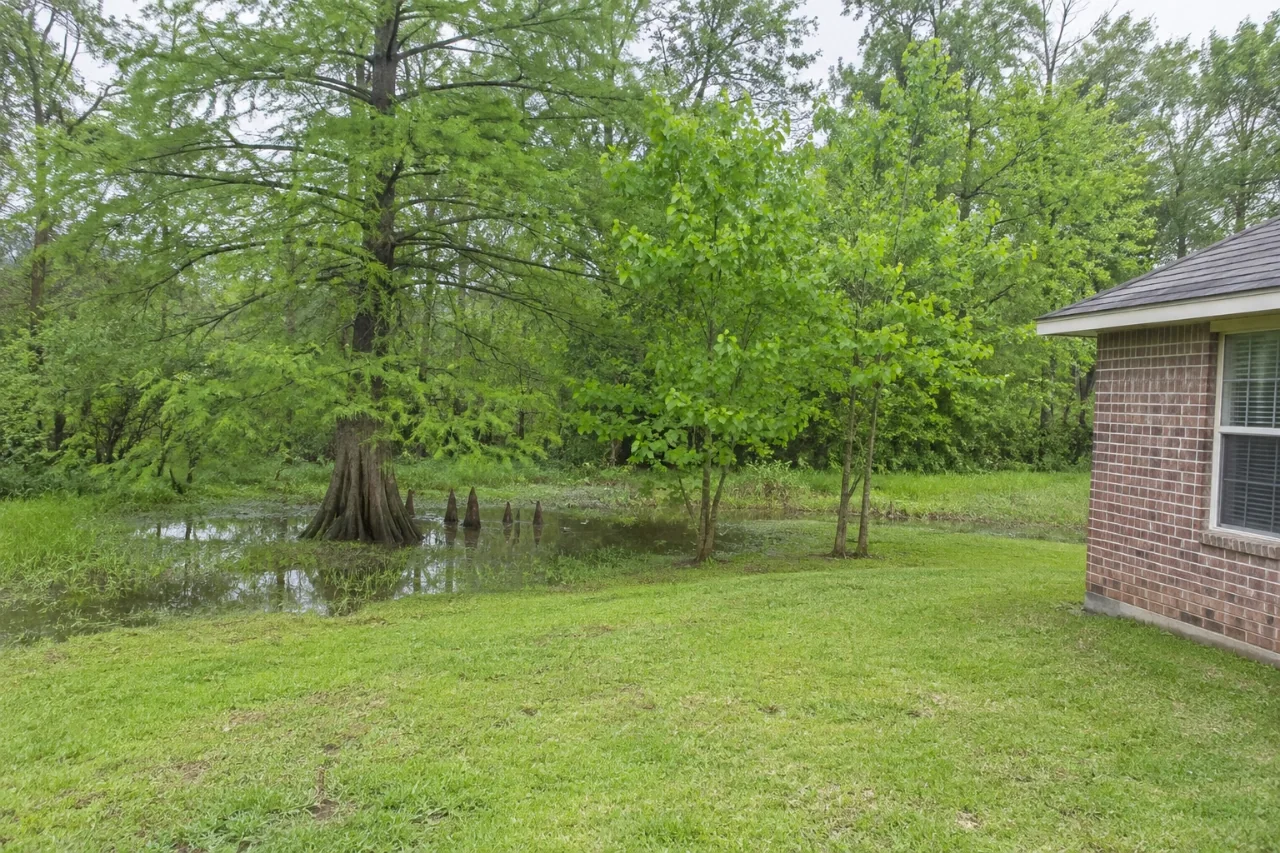
"Louisiana's state tree is the bald cypress," writes LSU AgCenter's Allen Owings. Trees can reach 100 to 120 feet "with a narrow, upright growth habit," grow fast for their first 10 years, "adapt to wet and dry soil conditions" and, "once established, can tolerate standing water." Its knees "are cone-shaped structures that grow from underground or submerged roots," and though it belongs to the redwood family, "which are mostly evergreen," it is "deciduous, losing foliage in winter," so a cypress turning brown in fall isn't dying (checked Nov 11, 2026). It's in FR173's highest group, on LSU's Survivor list, and in Denham Springs' native-tree table at 18 inches.
Chinese tallow
Louisiana law is clear about this one. La. R.S. 3:1791 recognizes Chinese tallow as "a noxious plant," "harmful to growth and development of beneficial plants and pasture," which "may be destroyed wherever found in this state" (checked Nov 11, 2026). LSU AgCenter calls it one of the worst invasive trees in Louisiana, says it came from Asia and was introduced to the United States in the 1700s, and says current control methods are "considered ineffective for long-term control"; USDA is working on biological control with two insects. The state wildlife department describes tallows as "small deciduous trees, rarely reaching 60 feet." FR173 puts it in the lowest wind-resistance group.
Since LSU says today's control methods don't hold tallow back for long, removing the big ones is only part of the job. Ask the contractor about grinding the stumps and dealing with the seedlings around them.
Pecan and Bradford pear
Pecan is in FR173's lowest group and on LSU's victim list, and LSU AgCenter researchers found that Formosan subterranean termites "showed a preference for pecan trees" (checked Nov 11, 2026). Bradford or Callery pear is also in the lowest group and on LSU's victim list as "ornamental pears." No Louisiana law listing Callery pear as invasive or noxious turned up for this site.
The ground under them
Two soil series have their official type locations in Livingston Parish. Colyell is "Somewhat poorly drained," formed in "thin loess over clayey deposits of Late Pleistocene Age" on "broad nearly level to gently sloping, convex stream divides." Satsuma, typed "about 1.75 miles southeast of Watson," is also "Somewhat poorly drained," and "The subsoil has a perched water table at a depth of 1.0 to 2.5 feet during the months of December through April." Both have a clay-enriched subsoil starting about a foot down, and the Colyell description gives mean annual rainfall of 64 inches (USDA, checked Nov 11, 2026).
Roots stay above that wet layer, the shallow-rooted setting LSU describes for its victim trees. The parish's rivers add another layer: in August 2016 the Amite at Denham Springs and the Tickfaw at Liverpool, Montpelier and Holden all reached historical crests (NWS, checked Nov 11, 2026), and LSU AgCenter's Dan Gill wrote that root rot and drowning are the greatest damage flooding does to landscape plants.
Pests and diseases to watch
- Pine beetles. Southern pine beetle is "Louisiana's most significant forest insect pest," but its activity "has been insignificant since the late 1990's," and Ips engraver beetles remain "at relatively normal levels" (LDAF, 2024 report). In a yard, the pine to watch is one stressed by drought, lightning or storm damage, which LSU AgCenter says beetles target.
- Formosan subterranean termites. LSU AgCenter says they "can make a meal out of almost any live tree," nesting inside it until it falls.
- Oak dieback. Mississippi State Extension lists live and water oak among the oaks most affected by Biscogniauxia (hypoxylon) dieback, which often follows drought by a year or two.
- Emerald ash borer. Not in this area. It was first confirmed in Louisiana in Webster Parish in February 2015, and the state's lists of affected parishes are all in north and central Louisiana; neither Livingston nor East Baton Rouge is on them (LDAF and the EAB information network, checked Nov 11, 2026).
- Laurel wilt. Reached Union Parish in north Louisiana in September 2014, with no new additions in 2024 (LDAF).
- Quarantines. None of the parish lists on LDAF's quarantine page names Livingston Parish; a few quarantines there are shown only on maps, and LDAF's emerald ash borer fact sheet lists only north Louisiana parishes (checked Nov 12, 2026).
What to plant in place of a lost tree
LSU AgCenter's guidance after removing a water oak points to live oak, Nuttall oak, cherrybark oak and Shumard oak, plus willow oak from the Louisiana Super Plants program: "There are enough oaks for selection to replace any failed water oak in the landscape." Bald cypress suits the wet back corner of a lot. Whatever you choose:
- Give it room to reach full size; a live oak spreads far wider than most people plan for.
- Keep it away from overhead lines. DEMCO says to "never plant trees near a power line right-of-way" (checked Nov 11, 2026).
- Call Louisiana 811 before digging the planting hole; its homeowner page names "even planting trees" as a way lines get damaged.
- Check the right-of-way: in Denham Springs, planting in a city right-of-way needs the landscape review coordinator's permission.
Questions about local trees
What's the safest big shade tree to have near the house here?
By both the University of Florida and LSU lists, live oak and bald cypress stand up to wind best, provided they have room and sound roots. Even so, nothing is storm-proof.
Should I remove the Chinese tallows along my back line?
Louisiana law lets anyone destroy Chinese tallow wherever it's found, and LSU calls it one of the state's worst invasive trees. Small ones are a simple job; ask about the stumps and seedlings.
Is emerald ash borer a threat in Livingston Parish?
Not according to the state's current lists, which show it only in north and central Louisiana parishes as of the sources checked Nov 11, 2026.
Why do shallow roots matter so much here?
The parish's own soils hold water a foot or two below the surface for months, so roots stay shallow, and LSU's "victim" trees are exactly the shallow-rooted, top-heavy kind that snap or uproot in storms.
Questions about any of these trees can be sent from this site; one independent contractor working in Livingston Parish receives them.
Where this comes from
- UF/IFAS, Wind and Trees: Lessons Learned from Hurricanes (FR173, no date shown); LSU AgCenter, Choosing trees for hurricane resistance (Jan 14, 2007). Checked Nov 11, 2026.
- LSU AgCenter: Dan Gill, As strong as an oak; Allen Owings, Southerners love live oaks and Consider bald cypress; Water Oak Warning; Chinese tallow (Jun 29, 2020); Louisiana Agriculture, fall 2007; Pub. 3092; Dan Gill on flood damage (WRKF). Checked Nov 11, 2026.
- USDA Forest Service, Silvics of North America: loblolly pine, water oak, sweetgum. USDA official soil series descriptions, Colyell and Satsuma. Checked Nov 11, 2026.
- La. R.S. 3:1791; Louisiana Department of Wildlife and Fisheries, Invasive Plants. Checked Nov 11, 2026.
- LDAF Office of Forestry, Louisiana Forest Health Highlights 2024 and quarantines; LDAF, emerald ash borer fact sheet (March 2026); emeraldashborer.info, Louisiana; Mississippi State University Extension, Biscogniauxia dieback. Checked Nov 11, 2026.
- NWS New Orleans/Baton Rouge, Watson tornado survey and August 2016 flood stage report; City of Denham Springs, Landscape Ordinance; DEMCO, right-of-way maintenance; Louisiana 811, homeowners. Checked Nov 11, 2026.